
Open x86 foundation
- Standard 19” 1U rackmount IPPBX appliance
- x86 motherboard path aligned with server-style deployment
- CPU-tier selection through IX160 and IX160P
OpenVox IX160(P) is a standard 19” 1U x86 IPPBX platform for enterprise voice-core projects that need open-system deployment, PCIe telephony-card expansion, high concurrency, and continuity options.
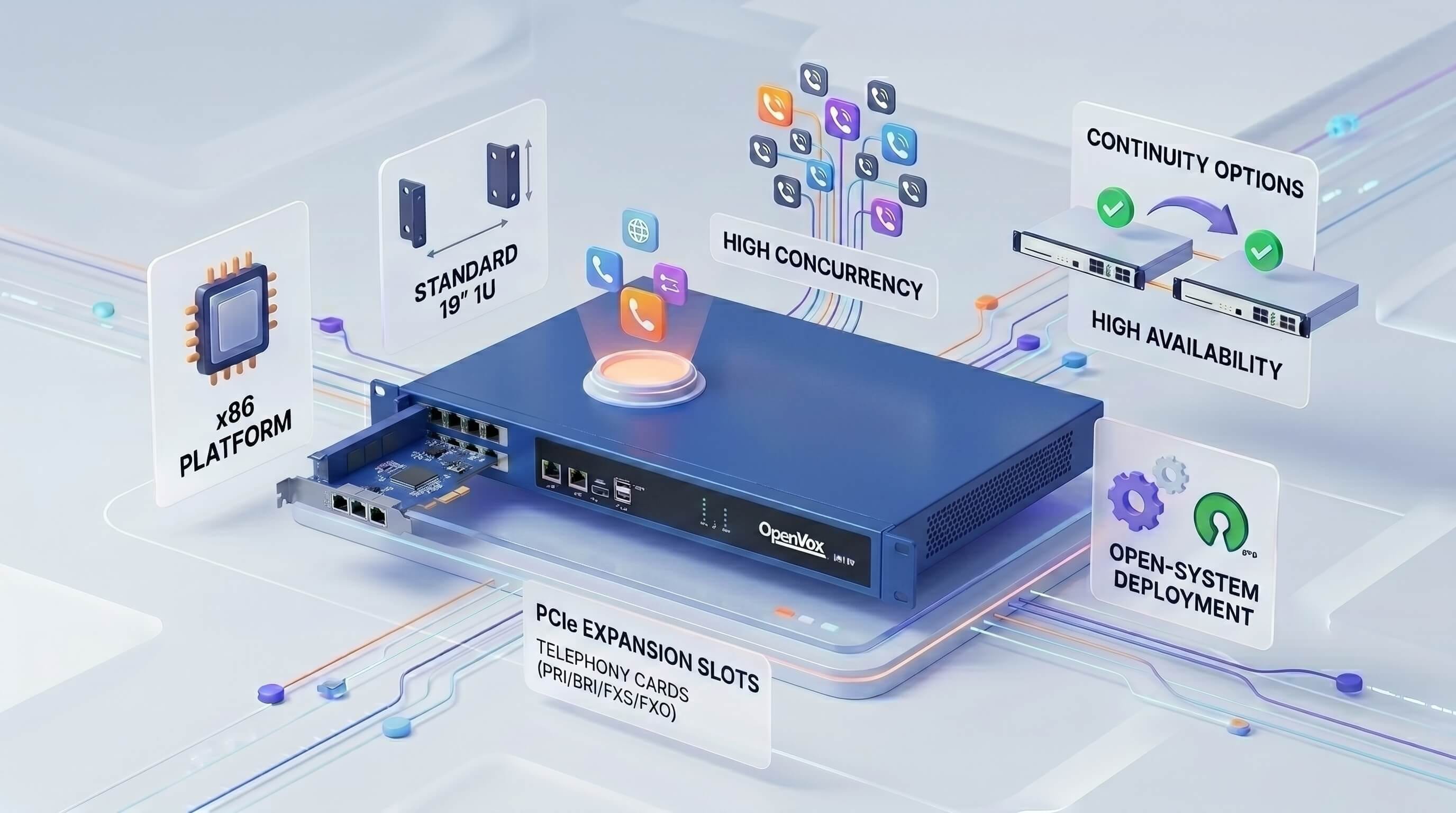
The real IX differentiator is architectural openness: x86 motherboard deployment, selectable PBX software, and PCIe telephony-card planning for enterprise projects that do not fit a fixed appliance path.
Use IX160(P) when platform selection depends on x86 motherboard class, PCIe telephony cards, and PBX software choice.
Deploy IX160(P) as a fixed 19” 1U IPPBX when the project needs a compact rackmount host with clear hardware boundaries.
The IX platform follows the x86 motherboard route, keeping system selection closer to standard server deployment.
Two PCIe slots let IX160(P) carry the analog, BRI, or E1/T1/J1 interface mix the project needs.
Keep PBX software selection open across OpenVox UC system and other supported PBX stacks instead of one fixed appliance stack.
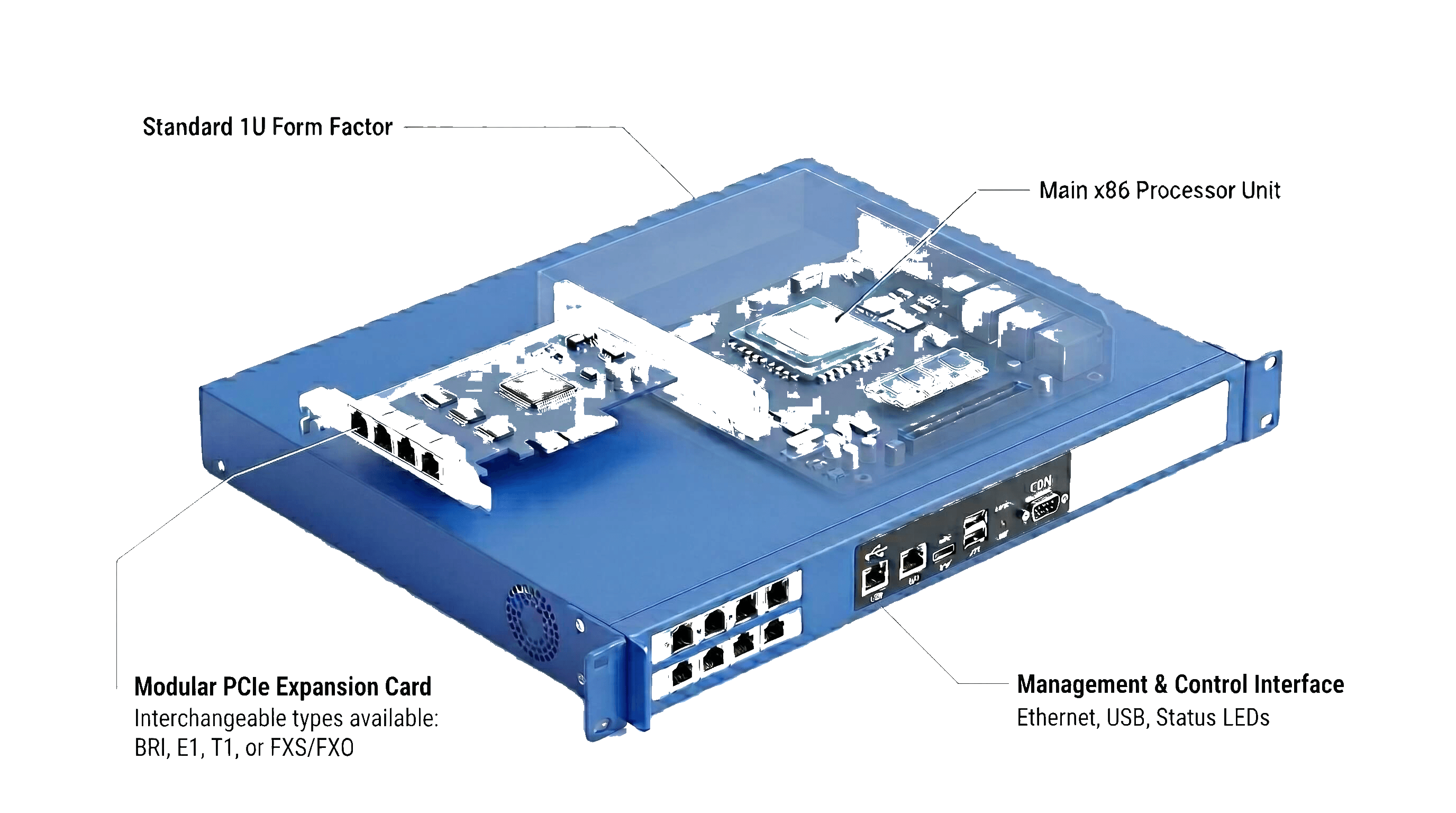
For enterprise IX deployment, power and storage protection are essential to data security, service continuity, and long-term system stability.
Built-in RPS helps IX maintain stable operation during power-side faults, protecting service continuity and reducing avoidable business interruption.
Optional UPS backup strengthens IX resilience under abnormal power conditions, helping preserve data integrity and keep call service stable during outages.
Optional hardware RAID 1 adds storage redundancy for business data protection, reducing single-disk risk and improving operational stability.
Compare the core hardware profile, interface resources, and system capacity of IX160 and IX160P in one concise specification view.
| Specification | IX160 | IX160P |
|---|---|---|
| CPU | Intel Celeron N4120 | Intel Core i7-1195G7 |
| Cores | 4 cores / 4 threads | 4 cores / 8 threads |
| Max frequency | Up to 2.60 GHz | Up to 5.00 GHz |
| Memory | Up to 8GB DDR4-2400 | Up to 32GB DDR4 |
| Default storage | 128G SSD | 128G SSD |
| Network | 2 * 10/100/1000 Mbps | |
| USB | 2 * USB 2.0 | 2 * USB 3.0 |
| Telephony | 2 * PCIe slots for FXS/FXO, BRI, or E1/T1/J1 cards | |
| Recommended users | 500-1000 | 5000-10000 |
| Concurrent calls | 200 | 1000 |
| Power input | 100-240VAC, 50-60Hz | |
| RPS (Redundant Power Supply) | Built-in redundant power supply | |
| UPS | Optional | |
| RAID 1 | Optional | |
Keep the next step practical: verify specifications, collect rollout documents, download firmware, and open technical support paths from the same UC evaluation section.
Resources
Documentation hub for manuals, rollout references, quick-start material, and supporting guides that help teams prepare UC deployment and maintenance work.
Resources
Official datasheet library to confirm capacity, interfaces, and hardware baselines before final model selection or project quotation.
Resources
Firmware and maintenance packages for system updates, post-rollout upkeep, and version alignment across deployed UC systems.
Support
Submit technical cases when deployment scope, interoperability, or after-sales troubleshooting needs direct engineering follow-up.